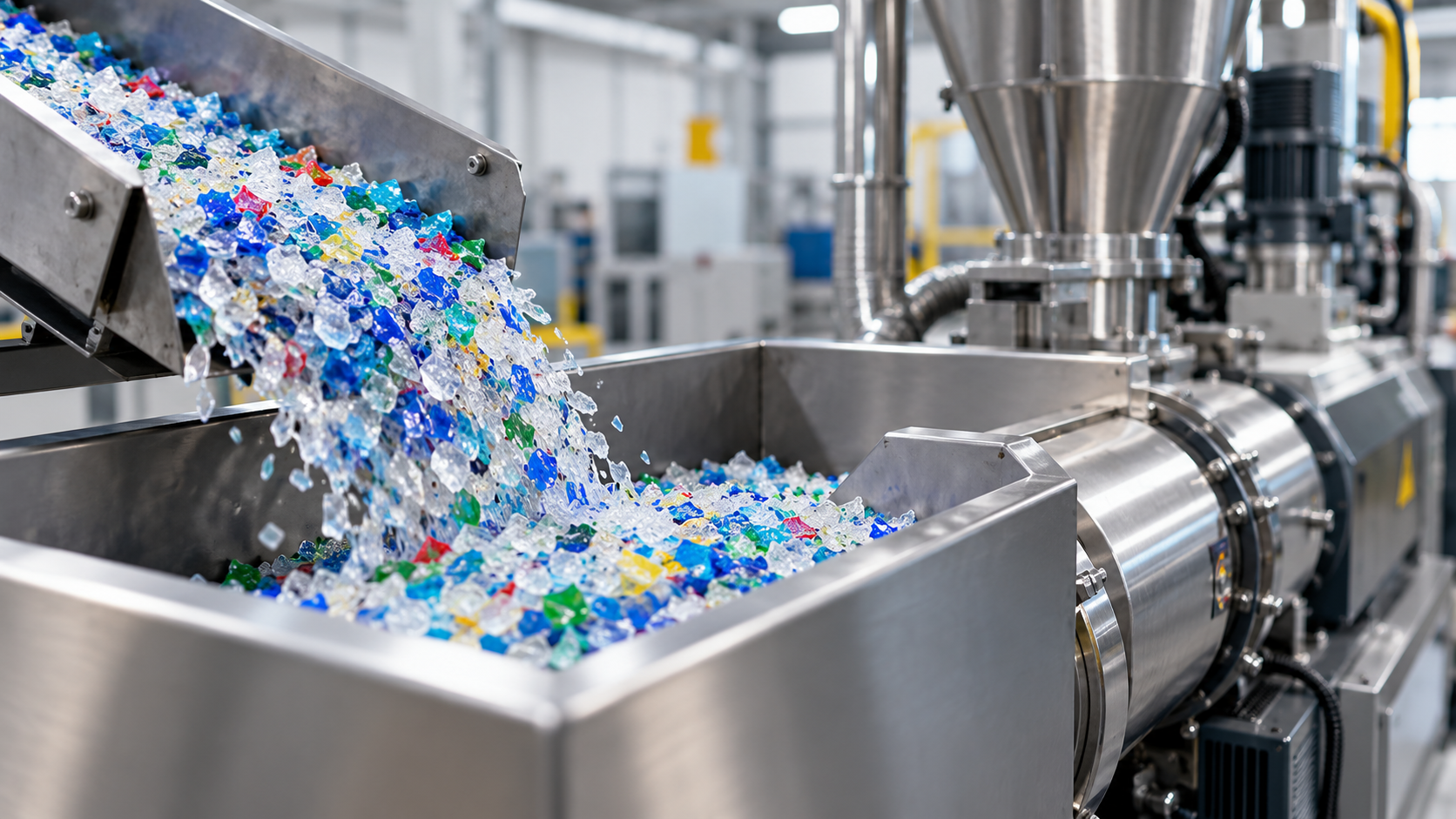
The increasing use of recycled plastics is changing the demands placed on processing equipment. Unlike virgin polymer, recycled material can contain varying levels of moisture, trapped air, volatile compounds and residual contamination.
For extrusion and recycling processes, effective vacuum is therefore about more than simply achieving a specified pressure. The vacuum system must reliably remove unwanted gases and vapours while coping with the realities of the process.
Why is vacuum important in plastic extrusion?
During extrusion, the polymer is heated and processed through the extruder. Moisture, trapped air and volatile substances can be released from the molten material.
Vacuum applied to the extruder vent removes these gases and vapours before the material continues through the process.
Effective degassing can help improve:
- consistency of the polymer melt
- removal of moisture and volatile compounds
- finished product quality
- overall process stability
This becomes particularly important when processing recycled material, where feedstock conditions may be less consistent.
The challenge isn’t always the vacuum level
When selecting a vacuum pump for extrusion, pressure and pumping capacity are important — but they shouldn’t be considered in isolation.
A more important question is:
What is actually entering the vacuum system?
Depending on the recycling process, the extracted stream may contain moisture, condensable vapours, fine polymer particles and other process contamination.
If these materials are allowed to reach the vacuum pump, they can cause deposits, contaminate operating fluids and increase maintenance requirements.
This is why we consider the complete vacuum system, not simply the pump.
Correctly selected filters, separators, condensate vessels and knock-out pots can help remove contamination before it reaches the vacuum pump and significantly improve system reliability.
Which vacuum pump technology?
There is no single vacuum pump technology suitable for every plastics recycling or extrusion application.
Liquid ring vacuum pumps are extremely robust and well suited to processes involving significant moisture. However, they require a sealing liquid, normally water. Where contaminants enter the pump, this can also create a wastewater stream requiring treatment or disposal.
Oil-lubricated rotary vane pumps can achieve deeper vacuum levels, but applications involving moisture and process contamination need careful consideration to protect the pump oil.
Dry claw vacuum pumps provide an increasingly attractive alternative for suitable extrusion and degassing applications.
With no oil or water required within the pumping chamber, dry claw technology can eliminate sealing-water consumption and reduce the risk of process contamination affecting pump fluids.
Eurovacuum’s ICV dry claw vacuum pumps provide capacities up to approximately 950 m³/h and ultimate vacuum levels down to 50 mbar absolute, making them suitable for a wide range of industrial plastics applications.
Dry doesn’t mean unprotected
Changing from a liquid ring or oil-lubricated pump to dry vacuum technology does not remove the need for good system design.
Polymer particles, liquid carryover and condensable vapours should still be prevented from reaching the pump wherever possible.
A well-designed system may therefore incorporate inlet filtration, condensate separation or a knock-out vessel before the vacuum pump.
The result is a vacuum system designed around the process conditions, rather than simply the required m³/h.
Reducing water consumption in plastics processing
For recycling businesses looking to reduce water consumption, dry vacuum technology can also offer an important advantage.
Replacing a water-sealed vacuum system with an appropriately selected dry vacuum pump removes the continuous requirement for sealing water and the associated contaminated water stream.
The suitability and potential savings will depend on the individual process, but it is an area worth investigating when reviewing existing extrusion vacuum systems.
Selecting the right vacuum solution
Every plastics process is different.
Before recommending vacuum equipment, we consider the required operating vacuum and capacity together with temperature, moisture, contaminants, operating cycle and the materials likely to enter the vacuum line.
At Eurovacuum Products, we supply dry claw, liquid ring and rotary vane vacuum technologies, allowing us to consider the application rather than promoting one pump technology for every process.
If you are reviewing an existing extrusion vacuum system or developing a new plastic recycling process, talk to us about the application and operating conditions.