Liquid Ring Pump
Overview
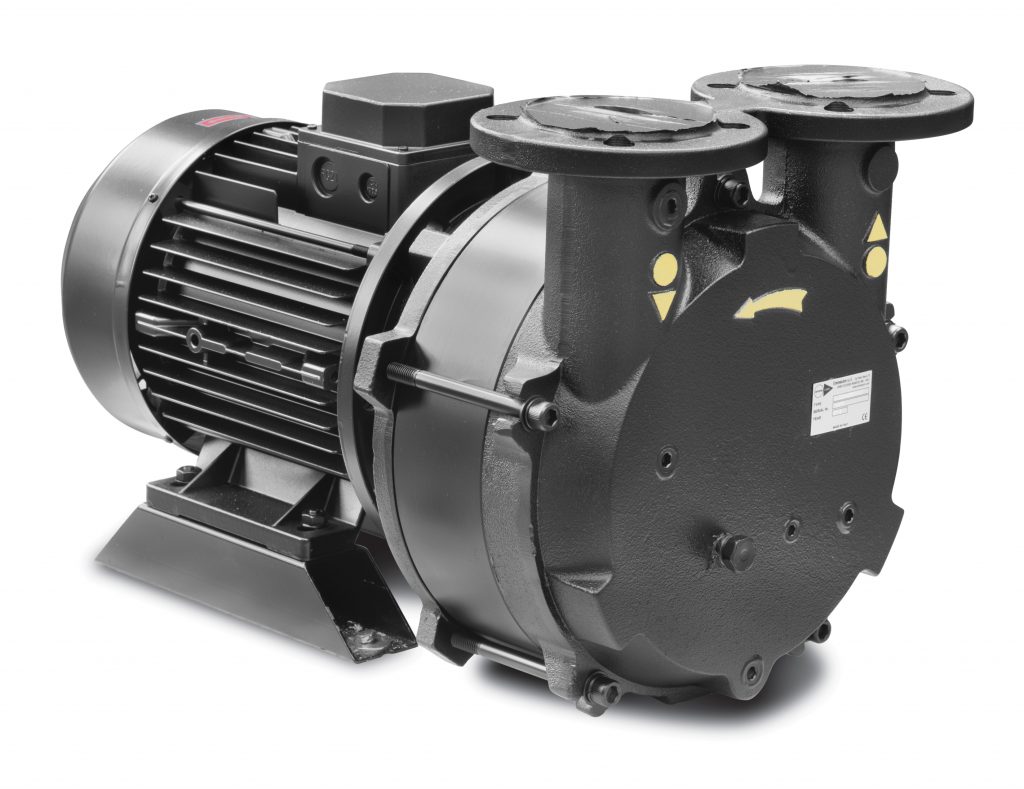
Designed and manufactured to be used in the most critical applications, their main feature is that they are suitable to suck contaminated gas mixtures, aggressive gases and vapors, explosive gas and vapors of any nature down to a conventional end vacuum of 33 mbar absolute. Produced according to the highest quality standards, liquid ring vacuum pumps belonging to the AL series are available in different materials to withstand the various process conditions. The product line offers three solutions: monoblock for those who need compact constructions, with intermediate supporting lantern and bareshaft.
The last two versions can also meet ATEX requirements.
Models
Technical Features
The Versatility of Liquid Ring Vacuum Pumps – from contaminated fluids to priming action
Liquid ring vacuum pumps work on a similar principle to a rotary vane compressor or rotary vane pump. The liquid ring vacuum pump effectively stirs the liquid it is pumping into a vortex, creating a pressure seal without the complexity of diaphragms, valves or a reciprocating element.
Liquid ring pumps are simple to operate and therefore low in maintenance as the rotor is the only moving part. They are also efficient because their operation is based on rotary motion rather than reciprocation and their design is inherently low in friction.
Developed over 100 years ago, their design has been steadily refined and today they remain a popular choice for a wide range of applications in many different industries. Standard materials of construction include bronze or stainless steel for the impeller and cast iron or stainless steel for the housing. Other materials such as Hastelloy are also available for special applications.
Liquid ring vacuum pumps comprise of a main body forming a cylindrical pumping chamber, with its axis horizontal. Within this, a vaned impeller is eccentrically mounted (i.e. its axis of rotation does not align with the axis of the chamber; it is parallel to it and somewhat lower). Inlet and outlet ports are located in the flat endplates with their positioning being very important.
Product Download Operation In use, vacuum pumps are about half-full with liquid and the rotation of the impeller churns it into a vortex-type motion around the wall of the pumping chamber. The spinning liquid effectively seals the space between each pair of adjacent vanes into individual cells.
The cells vary in size as they rotate through a complete revolution. At the very bottom the length of the cell is equal to the radius of the chamber less the distance of eccentricity; at the top it is equal to the radius of the chamber plus the distance of eccentricity.
As a cell rotates upward from the bottom, its length increases which reduces the pressure within it. Conversely, on the second half of the rotation, the cell is descending and its length is reducing, which pressurises the cell.
The inlet port is located on the upstroke side of the rotation, so that the reducing pressure sucks fluid into the chamber. A short time later it is pumped out of the chamber through the outlet port located 180degs away on the downstroke side.
Liquid ring pumps are available as single-stage or double-stage units. Although theoretically possible, three- and more-stage units are rare. Typically, a two-stage pump has a single shaft and two aligned but separate compression chambers, each with its own impeller.
Main applications fields:
| Application / Industry | Typical Use of Liquid Ring Vacuum Pump |
|---|---|
| Chemical & Petrochemical Processing | Vacuum distillation, solvent recovery, vapor handling, absorber/stripper operations, and handling corrosive or condensable gases. |
| Oil & Gas / Refining | Vacuum dehydration, flare gas recovery support, vacuum column evacuation, crude oil processing, and vapor recovery in refineries. |
| Power Generation | Steam turbine condenser air extraction, priming pumps for circulating water, vacuum deaeration, and maintaining condenser vacuum. |
| Pharmaceutical Production | Vacuum drying, solvent stripping, crystallization, and evaporation processes involving moisture or solvent vapor loads. |
| Food & Beverage Processing | Vacuum evaporation, concentration of juices or extracts, vacuum cooling, and dehydration involving large volumes of water vapor. |
| Paper & Pulp Industry | Paper machine dewatering, vacuum couch rolls, wire section vacuum, and improving sheet formation by removing water-laden air. |
| Mining / Metallurgy | Vacuum filtration of slurries, moisture-rich gas handling, vacuum-assisted separation, and mineral concentration processes. |
| Plastics & Rubber Processing | Degassing of polymers, vapor removal from extruders, and handling volatile monomers or plasticizers. |
| Environmental / Wastewater Treatment | Vacuum priming, aeration support, vapor extraction, and off-gas handling in treatment plants. |
| General Industrial & Process Plants | Vacuum filtration, drying chambers, vacuum impregnation, vacuum forming where moisture/vapor loads are high. |